
Skip to content

North and south coast invertebrates group

Devon is the only county in England with two coastlines. They help to create the county’s hugely diverse coastal habitats.

All Lizard Weevils are females and lay eggs that do not need to be fertilised.  

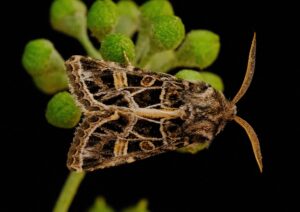
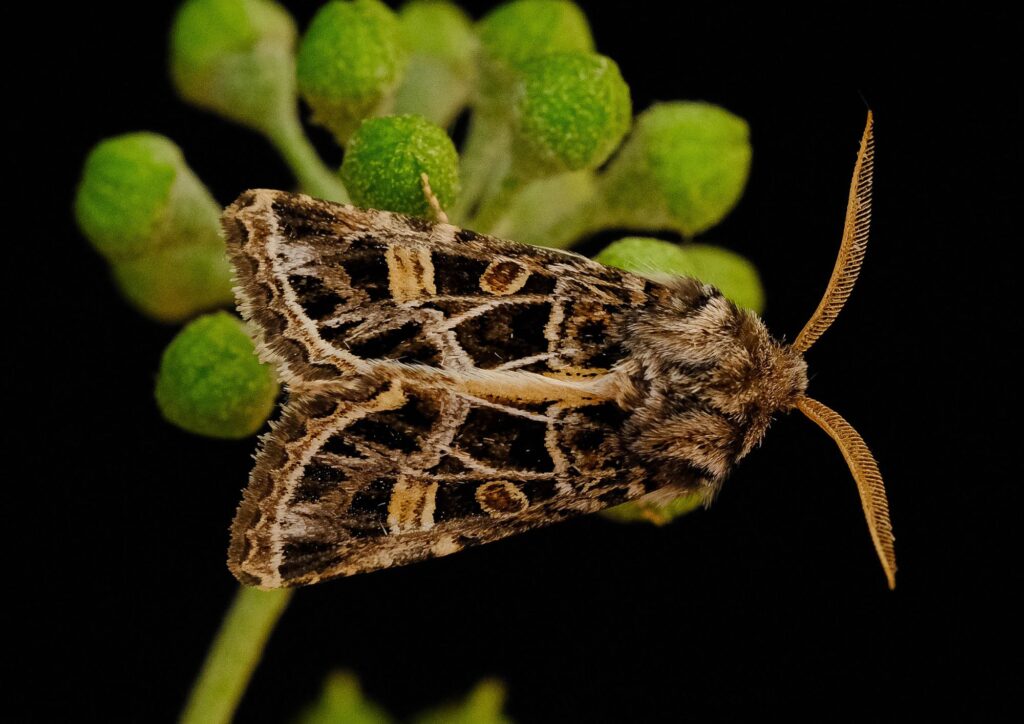
Intricately patterned brown and black moth, the beautiful gothic, on a green plant.

Beautiful gothic, Paul Burgess

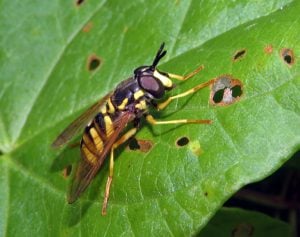
A variable meadow fly sits on a shiny green leaf. The fly has six yellow legs, a black and yellow striped abdomen and body, as well as clear light brown wings that lie flat parallel to the body. The large black eyes sit above a bright yellow mouthpart and between them are two short, stout, black antennae.

Variable meadow fly, John Walters

1. About

The cliffs, coastal grasslands, shingle and rocky shores along Devon’s two coastlines support a wealth of wildlife, including rare invertebrates. Many of these are very specialist and rely on coastal plants, such as thrift and Sea Campion. Others were once more widespread but are now largely restricted to wildlife-rich coastal habitats.

This group includes species which are largely found scattered on the north coast and the south coast (largely west of the Exe). Coastal invertebrates which are largely found in specific parts of the coast are discussed in other sections. See Species page.

Devon Special Species scattered along both coasts are discussed below. There are lots of other invertebrates found along Devon’s coasts which are listed as Devon Species of Conservation Concern. These include the Black Mining Bee (Andrena pillipes).

Key pressures and opportunities

Lack of grazing is causing a loss of sunny, open and bare ground and allowing shrubby vegetation such as gorse and bracken to become dominant. Some tree planting schemes are also causing habitat loss. However, organisations such as the National Trust and projects such as Life on the Edge are reintroducing grazing. See Inspiration below.  

The conversion of flower-rich cliff-top grassland to intensive arable production has in the past led to loss of invertebrate habitat. Cultivation close to the cliff edge continues to be a problem in some areas.

The use of increasingly powerful biocides and pesticides on farmland adjacent to wildlife-rich habitats on the coast is having a harmful effect on invertebrates.

In some parts of Britain, invasive members of the South African plant family Aizoaceae have colonised coastal cliffs. The main problem species is Hottentot-fig (Carpobrotus edulis), which is well-established at Croyde Bay in north Devon. It’s also been recorded on the south Devon coast and could become a problem.  The garden rose Rosa rugosa is spreading on the south Devon coast. This is not yet a significant problem but, as for Hottentot-fig, could rapidly spread and become a significant problem for native wildlife.

Life on the Edge is funded by the National Lottery Heritage Fund. The project focuses on the rare invertebrates and plants found along the south Devon coast and provides huge opportunities for nature recovery over the next few years. See Inspiration below.    

2. What we need to do and where

Devon Special Species

See Find out more below for links to more detailed information on this group including management advice and records.

A variable meadow fly sits on a shiny green leaf. The fly has six yellow legs, a black and yellow striped abdomen and body, as well as clear light brown wings that lie flat parallel to the body. The large black eyes sit above a bright yellow mouthpart and between them are two short, stout, black antennae.

Variable Meadow Fly

Chrysotoxum elegans

The Variable Meadow Fly uses its yellow and black stripes to mimic wasps. It lives in open, sunny, flower-rich coastal grasslands. It’s largely found along the south Devon coast but also occurs in a few places along the north coast. It’s an attractive species and can act as a flagship for the management of coastal grasslands. 

The Variable Meadow Fly is nationally scarce and thought to be declining across the country due to loss of habitat. As for other species in this group, a key issue is loss of coastal grasslands due to lack of grazing.   

Image needed

Lizard weevils

Cathormiocerus attaphilus, Cathormiocerus maritimus and Cathormiocerus myrmecophilus.

These brown, flightless weevils (a beetle) are rare and only found on the Atlantic fringes of western Europe. They’re named after the Lizard peninsula in west Cornwall.  

Lizard weevils are parthenogenetic, which means their populations consist entirely of females that lay eggs which do not need to be fertilised.  

There are three species in this group, Cathormiocerus attaphilus, Cathormiocerus maritimus and Cathormiocerus myrmecophilus. They’re all largely found in Devon and Cornwall, with some records along the south coast of England and Wales. C. attaphilus is especially rare and found only in Devon and Cornwall.

They need short maritime grassland with patches of bare ground maintained through exposure to salt spray, erosion, grazing and thin, dry soil. They’re thought to feed on a range of plants but seem to prefer plantains. The key pressure is tall grassland and scrub caused by a lack of grazing.  

In Devon, all three are found between Wembury and Prawle Point. C. maritium and C. myrmecophilus are also found between Brixham and Froward Point (near Kingswear). C. myrmecophilus is also found on the north coast between Marsland and Clovelly.   

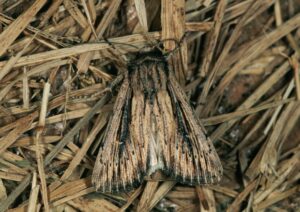
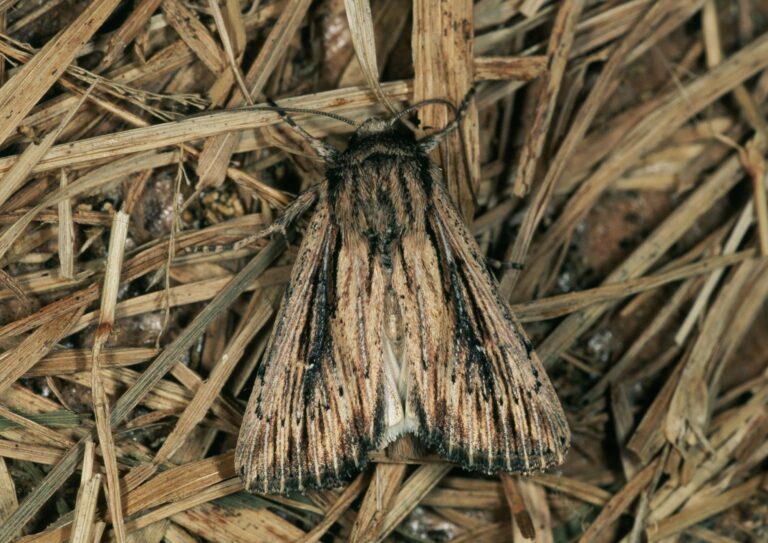
Sandy coloured devonshire wainscot moth with dark brown/black streaks

Devonshire Wainscot and other coastal butterflies and moths

This special group includes species that are largely found on the cliffs, coastal grasslands, shingle and rocky shores along Devon’s two coastlines. Some are very specialist and rely on plants, such as thrift and Sea Campion, which only occur in coastal areas. Others were once more widespread but are now largely restricted to wildlife-rich coastal habitats.

Moths which are characteristic of sand dunes, east Devon chalk and Torbay limestone are discussed in separate groups.

Devon Species of Conservation Concern include:

  • South coast only:
  • Sea Spurge Tortix (Acroclita subsequana): Caterpillars feed on Sea Spurge and Portland Spurge, spinning the leaves to the stem with silk. In Devon they’re recorded at Strete Gate Beach and Blackpool Sands.
  • Rolled Grass-moth (Pediasia contaminella): Caterpillars feed on grasses such as Sheeps’ Fescue. In Devon it is recorded at a few locations on the south Devon coast, the sand dunes at Dawlish Warren and a few records from the Pebblebed Heaths.
  • Both coasts:
  • Black-banded (Polymixis xanthomista): Recorded along the north coast between Ilfracombe and Hartland and scattered along the south coast. Restricted to rocky and stony areas where they feed on coastal plants such as thrift.
  • Barrett’s Marbled Coronet (Conisania andalusica): Recorded along the south coast and on the north coast between Ilfracombe and Hartland. Caterpillars feed on the roots of Sea Campion and Rock Sea-spurrey.
  • Scarce Moss-moth (Bryotropha dryadella): Caterpillars feed on various mosses and possibly leaves of short grasses growing within the moss.
  • Mere Wainscot (Photedes fluxa): Feeds on Wood Small-reed and in Devon is now mainly found along the east Devon coast and near Croyde on the north coast.
  • Thrift Clearwing (Pyropteron muscaseformis): Found on rocky shores and cliffs around Hartland and Bideford, on Lundy and on the south coast. Caterpillars feed in the stems and roots of thrift.
  • Garden Tiger (Arctia caja): Still widespread but declining and now only common in coastal areas. Caterpillars feed on a wide range of plants.
  • Cornish Snout (Nothris congressariella): In Devon only found on Lundy. Caterpillars feed on Balm-leaved Figwort, which has a very localised distribution. The population is thought to have expanded after Rhodedendron was eradicated.
  • Wall (Lasiommata megera): Declining, but much more widespread throughout England. Caterpillars feed on a wide range of grasses. It’s found in dunes and coastal habitats, but also disused quarries and derelict land with lots of bare ground.
  • Grayling (Hipparchia semele): Habitat requirement is similar to the Silver-studded Blue, needing open, sparse vegetation with fine-leaved grasses and bare ground. Grayling is more widespread than the Silver-studded Blue with records (2000 – 2009) on the Pebblebed Heaths, around the edges of Dartmoor and the south Devon and north Devon coasts.
  • Small Blue (Cupido minimus): Caterpillars feed on Kidney Vetch. Very locally situated in Devon. Main sites are east Devon coast, Torbay coast and Braunton Burrows. East Devon sites tend to be managed naturally by occasional cliff fall and erosion, which create ideal breeding conditions.

Four species are identified as Devon Special Species in their own right.

Sandy coloured devonshire wainscot moth with dark brown/black streaks

Devonshire Wainscot

Leucania putrescens

Caterpillars feed on various grasses through the winter and pupate in May. It’s known along the whole Devon coastline (including east Devon).

Intricately patterned brown and black moth, the beautiful gothic, on a green plant.

Beautiful Gothic

Leucochlaena oditis

Restricted to the south coasts of Devon, Cornwall, Dorset and the south-west coast of the Isle of Wight. In Devon, it’s been recorded at various sites heading west from Torbay. Caterpillars feed on grasses including Common Couch and Annual Meadow-grass.

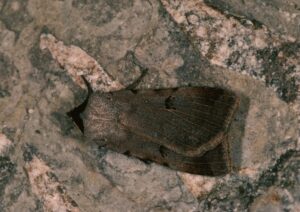
Dark brown-black moth on a rock

Scarce Blackneck

Lygephila craccae

Recorded in north Devon from Hartland Point to Woody Bay. Caterpillars feed on Wood Vetch and Tufted Vetch.

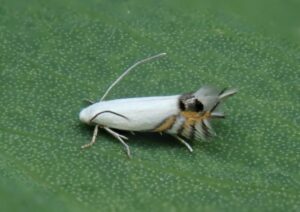
Small white moth with an orange stripe on a green leaf.

Everlasting-pea Blister Moth

Leucoptera lathyrifoliella

This micro-moth was only found on the coast between Shaldon and Branscombe and a few other locations including the Isle of Wight and one in Wales, but no longer occurs at Shaldon. Caterpillars feed on the Narrow-leaved Everlasting-pea. The Wight Pea Moth (Grapholita gemmiferana) has a very similar distribution and does not occur further west than Salcombe Mouth, near Sidmouth. It has the same foodplant.

Actions

Manage and restore (through light grazing and scrub control) a mosaic of connected habitats with flower-rich grasslands, bare ground, scattered scrub and trees, wet seepages, eroding cliffs, shingle and critical foodplants.

Monitor and control invasive species such as Hottentot-fig and Rosa rugosa.

Minimise the use of, and target applications of, pesticides to reduce impacts on invertebrates.

Other relevant actions

See the Coastal Wildbelt page for other relevant actions and coastal species.

Where to focus action

High Opportunity Areas: All Coastal Wildbelts. See Mapping.     

3. Inspiration

Case studies

Life on the Edge

Life On the Edge is funded by the National Lottery Heritage Fund. The project works with the National Trust, farmers, communities and wildlife experts to reverse the decline of rare species, including those listed above. It focuses on five hotspots: Wembury, the Erme, Bolt Head to Bolt Tail, Prawle Point to Start Point, and Brownstone to Berry Head. 

Life on the Edge an introduction

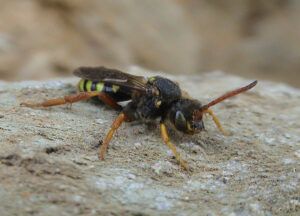
A six banded nomad sits on a grey rock facing the bottom right corner of the photo. It has orangey-yellow legs, orangey brown antennae, a black and yellow striped abdomen and a fuzzy black body and head. The dark, clear wings lay on top of one another against the abdomen, the large dark eyes are just below the antennae on on the head, and a lighter, yellow mouthpart is just visible below those.

Where to visit

Always follow the Countryside Code and keep to footpaths and sites that are managed for public access. 

Bolberry Down

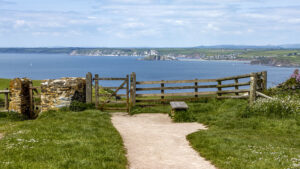
The National Trust have created an accessible-for-all circular loop, funded the the South West Coast Path Association, along the cliffs at Bolberry Down in south Devon. Not only is there a wonderful cafe and views, but also the chance to spot many different invertebrates, such as cliff-nesting bees and spiders.

A landscape with a flat path laeding to a gate and fence in the foreground and coastal views across the sea and cliffs in the background.

Berry Head National Nature Reserve

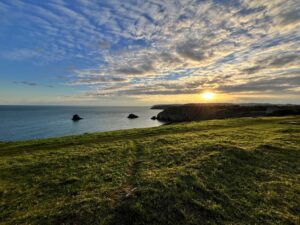
Berry Head is surrounded by water on three sides and is Torbay’s most designated heritage site being a Special Area of Conservation, National Nature Reserve, Site of Special Scientific Interest and Scheduled Ancient Monument, to name a few.

There are 28 species of butterfly, including the rare Small Blue, that flit through over 500 species of plants, a good number of them only occasionally found in the UK.

A landsca[e view of a field in the foreground, dropping off into the background of sea and cliffs against a setting sun.

For information on visiting these sites and others that are open to the public please see the Explore Devon website.

4. Find out more

See the main species pages for links to useful information including recording schemes: Moths, Flies, Beetles.

Caring for coastal footpaths | National Trust

Environment – South West Coast Path

Listed in order of appearance:

  • Beautiful Gothic Moth- Paul Burgess
  • Variable Meadow Fly- John Walters
  • Variable Meadow Fly- John Walters
  • Devonshire Wainscott Moth- Barry Henwood
  • Devonshire Wainscott Moth- Barry Henwood
  • Scarce Blackneck Moth- Barry Henwood
  • Everlasting-pea Blister Moth- Phil Barden
  • Six-banded Nomad Bee- John Walters
  • Bolberry Down- Hugh Mothersole
  • Berry Head National Nature Reserve, Charles John

Draft